Tuesday, November 6, 2012

Eastern Europe: Tripping on the Train


(Sorry, no photos. I'm way too preoccupied to stop & take pics on the train. There will be plenty for upcoming Passau, Regensburg, & Saltzburg.)

For the life of them none of our kids--and now that includes our daughters-in-law making 14--understands why we like to take trains when we go to Europe. The last swing from Hungary to Slovakia, through Austria to Bavaria, & finally to Munich was aboard the (in)famous  long distance trains. If J.J. & I did not have at least one major leg on our tour by train, we would feel like we had cheated, or something. How can we pretend to have European roots if we do not take the train? It’s the stuff that novels and spy movies are made of, even if, for us, there is no plot. All the same, a train passenger during that moment lives on a stage composed of train stations & big compartmentalized trains. The backdrops are constantly morphing into different countries with cities large and small. The characters, with languages and cultures matching their homelands, enter and exit leaving indelible impressions, never aware that they are being observed by outsiders from another world. 

Over the protestations of #3 who insists that trains are expensive, slow, and a big hassle, we are of a mindset that traveling is not always about getting from point A to point B. If that is all one wants then take Easy Jet. You’ll spend most of the time you save waiting in lines, listening for garbled announcements, & being delayed by endless stupidities--such as blowing up suspicious unattended suitcases. At boarding, one begins to feel sympathy for beasts being herded to the slaughterhouse. I ask you, how is the whole process of “security” check much different?  For commuter planes one must climb an outdoor flight of stairs -- resembling fire escapes!--only to push one’s way into a kind of wholesale, super-sized coffin for about 150+ people. The sight is comical to watch as most passengers have big bulging soft travel bags that they force into inadequate, overhead bins. Of course, passengers have the option of checking their large bags but would never do so for fear of never seeing them again. (Oh yes, on this I can sympathize!) I could go on with a litany of inconveniences and even grievances, but I’d much prefer to extol the virtues of rail.

Hence, we two seniors do our best to travel with bags that are a reasonably light tote because, for sure, we are in for a lot of toting. In fact, we are in for a lot more than that because the bags must be hoisted from the quay about two & a half feet high onto the train. Once on board we must hoist our bags onto luggage racks leaving all walkways absolutely clear. The good thing about trains is that there is generally a lot of room on the racks & generous seating. Since we don’t usually have to hurry to sit down and get buckled in, as in planes, we have all our time. Many times a young person -- male or female -- will offer help us with our bags. See? Young Europeans can be so polite! Actually, J.J. & I often get help when we are negotiating stairs & such in stations. From then on we just relax, take in the beautiful scenery, read a book, snack, or snooze. 

Okay, so boarding the train has its challenges, too. Lately (as I’ve mentioned before), there has been a trend in Europe to announce the train and quay only minutes before the train is scheduled to pull out. While Europeans who are used to this phenomenon & are unfazed by this last minute sort of thing, we outsiders  feel disadvantaged. Such was the case when we left in Presov, Slovakia at 9 a.m. Luckily Viktor was there to help us! We surely could not know anything trying to understand Slovak on the intercom. Asking someone is fine & we will always do it, as you will see, but people don’t like to be stopped for information when they are in a hurry to catch their own train, plus they must try to think in English. Who can blame them for being a bit brusk? 

Here I must digress a bit and tell you about trains in Hungary and Slovakia: they are still quite antiquated. As previously mentioned Hungarians have updated and modernized the Budapest station, but most stations are still lagging in this respect. The Bratislava station is so dated & impractical that those progressive Slovaks ought to refurbish it soonest, if for no other reason than making a good impression.  An old train might be roomy, but it is tired from long years of service and generally toilets function very poorly, if at all. It does not have air-conditioning unless you count open windows with whipping wind. June was fine for interior temperature and air circulation; but in the summer months one will really get to experience how it used to be without AC! So, for this last train trip we had rather inferior trains in Hungary, Slovakia, until Vienna where we changed to a cushy, modern, air-conditioned train with working toilets. It follows that older trains are definitely slower than the new ones. The new trains are like a fast flowing cloud.

Still, I must insist that for enjoying the sights, scenery and local folks that the train is the way to go. Most Europeans do not take the train for a long trip. Their limit is about 50 miles or two or three stations. Maybe their work is located a few stops away. Many times it is obvious that passengers are making a family visit. We've seen & spoken to grandparents who have just fetched their grandchildren for a summer visit. By going through the same regular things that most citizens do, we are getting a real taste of each country as we pass through. Go figure: flying is just a few hours in the "coffin," confined & all strapped down, only to arrive at another airport with nothing special to remember. Where are there any remnants of old world elegance or quaintness to compare with trains?

The second time we had to get instructions was in Vienna where, because of extensive renovation on the designated station, there was a complicated change to make. We actually had to leave the long distance passenger train just before Vienna, catch a suburban train to the main station, and then find the quay for our train to Passau. Fearless J.J. asked a burly, red-faced Austrian conductor to give us instructions to which he refused (in loud German), turning to the “audience” of passengers and commenting that he didn’t have time to fool with Americans. Well, we never give up because one conductor acts like a clod. The next conductor, a skinny, distinguished grey-haired sort told J.J. (in German) “Just wait. I have to check everyone’s ticket. I’ll take care of you after that.” If you’re wondering, yes we can understand the “gist” of these simple instructions & the unkind comments made by Conductor Clod. Mr. Nice Conductor gave altogether understandable instructions with names of places where we should get off & then take a subway to the station. From there on it was an adventure, but not one which was impossible. We knew we had very little time to make this connection, but we did! 

We settled into the beautiful, modern train. J.J. and I did not sit together. Many times we don’t, as he likes to do his thing & I like to do mine.  I talked with Lauren, an Austrian French teacher for most of the way. As we watched the two-story rectangular farms pass by on the bright green hills, she explained that these structures actually housed a family and the farm animals! We spoke of many common experiences, teaching French, our host sons, her vacation house where she would be staying for the next month. She would be taking her students on a summer outing for a month in July. She and I spoke French, as was her preference so she could get in some practice. Okay, figure this: me retired French teacher - native language English; she French teacher - native language German. Ah! The beauty of the French connection! 

By the time we got to the Passau station #2 was waiting for us. He was rather amazed that we had actually made our schedule. He knew all about the change in Vienna & feared that we would get laid over. The only really big ordeal yet to surmount would be a train ride to the Munich airport where we would fly back to Paris. I’ll spare you that. Suffices to say, that J.J. & I made all of our trains with complicated connections. We might not be winners of the ubiquitous “Amazing Race,” but considering our age, it’s worth a brag in my blog.

Friday, October 26, 2012

Slovakia II - A Flowing Folksong


Protected Wood Sculture of Folk Musicians in Pieniny Park
The first night we stayed in the Trattoria there was a party in the courtyard which also serves as a restaurant. We fell asleep to the sounds of violin & accordion, rendering folksong after folksong sung or danced to by most patrons. I’m sure it lasted until way into the wee hours. Our owners said they host these musical occasions quite frequently. But, we were so tired that the music just became a background to our sweet dreams. 


Haven't I mentioned colors everywhere?
The visits with Viktor’s parents are always wonderful. For poor Viktor, though, I’m sure it’s work because he’s the translator. Of course, J.J. & I can’t speak Slovakian which is very close to Czech. This language is just as devilish as Hungarian, but it is considered a Slavic tongue, hence it has many “sisters.” 
Cheerful, n'est-ce pas?
As members of the thriving, upwardly mobile middle class the parents are thoroughly involved and informed about their country. Viktor’s father, a successful construction engineer, enjoys analyzing Slovak politics & asks pertinent questions to keep his pulse on the US and western Europe. He loves jazz & dreams of coming to a Jazz festival in the US. He also cultivates bonsai trees.


Very old
Not so old
Very New
Viktor’s mom is a sturdy, knowledgeable nurse who takes us into the mindset of the Slovakian culture & work ethic. Besides basic nursing training she apparently was well-trained in physical 
therapy. She knows precisely what a person must do to relieve muscular and joint aches and pains. (She sure takes care of Joanna!) At one time she was an olympic sprinter & she still lives like a competitive runner: life is serious business. She will take good care of everyone. (Love her cookin’!”) 


Best photo I have of Yara, Viktor's mom
Viktor is a licensed architect after many years of training. For a while he took off and worked in Bristol, England for a stint. With his overseas experience at age 31 he’s a sophisticated example of the generation who will soon be running the country. His practice for now is designing new homes and refurbishing old ones in Presov. 
Handsome Viktor en profile
While he is an independent, his girlfriend, Lucia, is also an architect & works for a firm in Kosice. Just a note: we noticed that for the present Presov is much more repaired and rebuilt than Kosice which lags. It has not yet quite recovered from those pesky Russians and Hungarians. 


Hotel and Tourist Center of Pieniny Park
We were invited to dine with Lucia’s family - sister & parents - to their lovely home in Kosice. We ate under a covered area of the back yard in the cool of the evening. The plat de resistance was trout, large and freshly caught by our host just that morning. We ate so much of everything we were bursting. 


Hey over there! Are you trout fishing? Are you sure it's legal?

Here again we enjoyed talking about many things happening in Slovakia. The subject I remember best - besides the food - had to do with different ethnic populations in Slovakia. Because the mother was working in television as a programing executive for minorities, she could relate many things about how television must reflect equitably various segments of the population. You’d be surprised. There are Hungarians, Muslims, Gypsies, & others who must be considered. This time Victor got some great assistance for translation from his one-day-to-be sister-in-law, Trina. I think it’s the first time I’ve been sitting next to someone who translated simultaneously like in the United Nations.  All I can do is admire because I could never think that fast.


Yara in the forground; Slovakian teens take a ride in a horse-drawn buggy.
Our special outing was a drive to the Pieniny (national) Park where we would ride a raft for several miles on the gentle currents of the river Dunajec.  I’m still impressed by two things. First, on the left bank was Poland. Second, it was the first & only time I have ever heard a real live cookoo! The photos will tell the rest.


Gentle Currents: The cookoo lives somewhere in the trees.


"Three Crowns," at 982 meters altitude, they are the highest point in the Pieniny mountain range; they are in Poland on the left bank of the Dunajec river.


Wednesday, October 24, 2012

Slovakia I - The Comeback Kid

I chose this photo taken from inside the car because I think it is typical of the simplicity, color, and green spaces in Presov.


Our next stop was eastern Slovakia. This is the second time we have gone to Presov (Preh’-shov) to visit our host son, Viktor, of 15 years ago and his family. The conversation is heady, leaning toward politics and morality. The food is hearty and wonderfully prepared. The activities are delightful but restful at the same time. 

At Viktor's father's house: An indoor/outdoor room 
Part of this is because we stay at the Trattoria owned and operated by Viktor’s friends of longstanding. (His treat, he insists!) While it’s called Trattoria (another Italian word for eatery) in fact it is a small hotel.  It must have been a rambling, roomy, old single residence of some quality with a generous interior courtyard in the days before WWII. The present owners are father-chef, daughter - business manager, &  son - operations. Since we came in the low season, we had a charming bedroom & bath in the old house, comparable to a B & B.  Before we arrived Viktor warned us that there might be some extra noise and disarray  because the owners were adding seven new rooms. This is a good sign. It means that this part of Slovakia is needing extra hotel rooms for business travelers & tourists.

Viktor in between translations; Beyond the green and the little red house we hear a choir singing Slovakian songs:  a celestial accompaniment as we converse.
We noticed many positive changes in Slovakia between our trips of August of 2005 and June of 2012. Here again the effects of the EU are obvious. In ’04 we were in Bratislava, the capital city, old and historic, largest in Slovakia. This time we stayed around Kosice (Ko-zee’-cheh) and Presov, what one might call provincial cities. Never think that I apply this term pejoratively. The provinces of a country can often vie with the big hubs. In this case one sees better why Slovakia doesn’t wish to bail out Greece or Spain. Obviously these are hardworking Slavs who have cleaned up from the Soviet days, refreshed and regenerated their economy. Whatever money the EU gave them has been properly applied: the bums are off the streets, gypsy eyesores are gone, half-finished street works are but few, city sanitation services are in place. Slovaks are bulldozing dead factories (with those horrid smoke stacks!), & rebuilding new ones on those sites. Most impressive is the car manufacturing corridor along the central highway. 

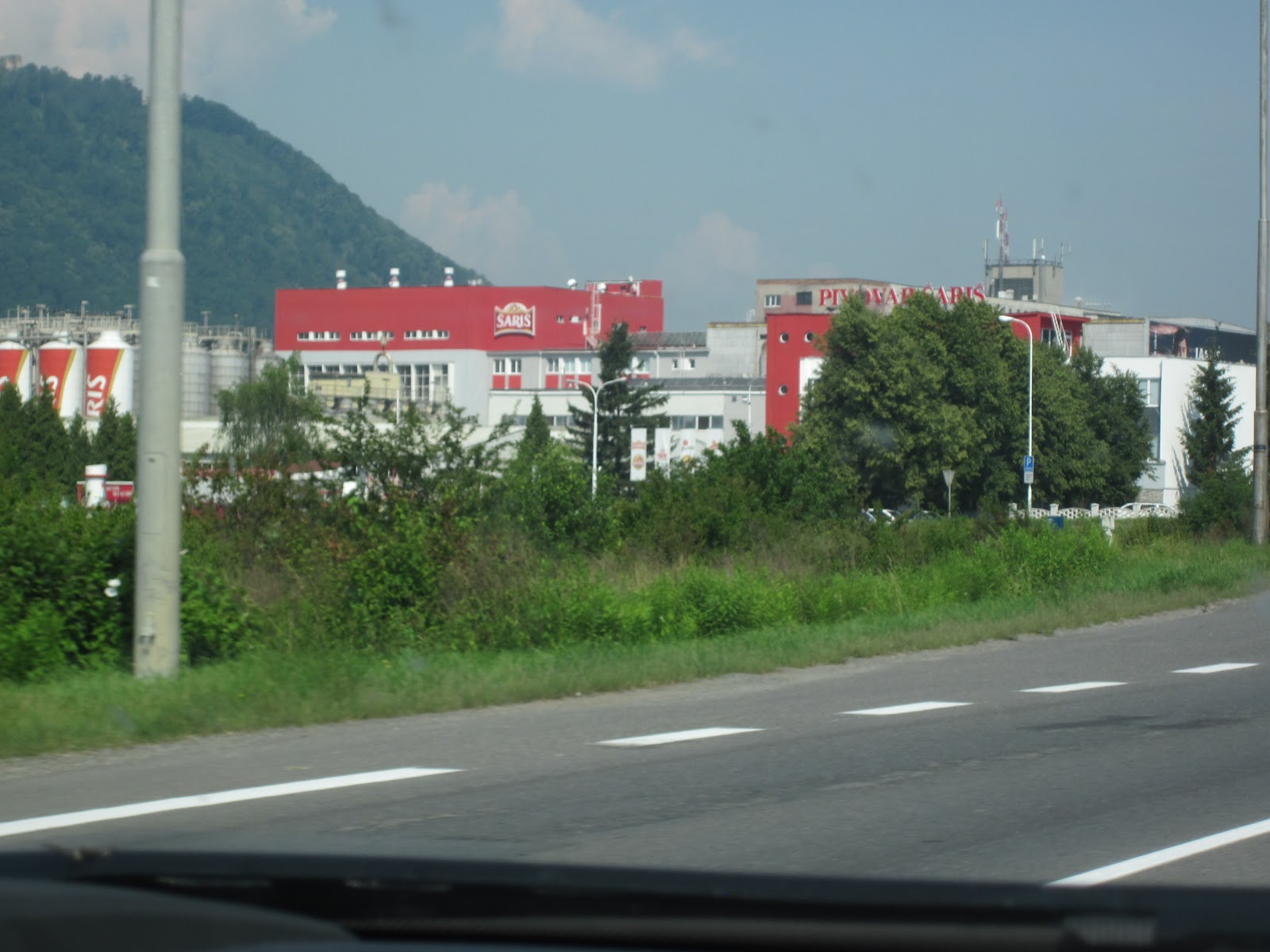
This might be a beer factory, but still it is representative of the many factories renewed or brand new.
A digression:

I’ve grown up knowing that my father at age 19 in 1938, left central Arkansas to work for the summer in the Ford Factory at Dearborn, Michigan. At the time he was an Industrial Arts major. When he reminisces on his experiences, he speaks with great respect for Slovaks and Poles who were masters of the foundry. They were kind and tolerant to a skinny, curious, green kid from the deep South. My father who eventually became a dentist learned the essentials of casting and metalworks from them. But, he always finishes his tale with, “I’ve never seen any human beings work harder than those Slovaks!” So, coincidentally,  in 2012 as we were riding along observing the car factories, I quoted what my father said. Viktor replied in a his charming Count Dracula accent, “Waal, da Slovaks alwez kom’plan abot werking, but dey weel dooweet anyway!” 

An official building freshened up: the crosswalk sign reflects the regulation continental signage required by the EU.
To return briefly to the position of Slovaks on bailing out Greece, et al.….We can totally understand their harsh stance: Slovaks don’t want to comply!  After such a long period of oppression being known as Czechoslovakia, in 1993, like Siamese twins, they were separated. Naysayers be damned! Little Slovakia is making a comeback. They are just beginning to prosper and whammy! Now, they must honor EU “solidarity” and bail out the lazy Greeks! 
Slovakia is a land of rolling hills.  Note the smokestack - a remnant of Soviet occupation.
We would not say that Slovaks are US-style capitalists, but they are hardly naïve concerning the ins-&-outs of socialism. The political right has struggled to push back the left, especially composed of aging citizens psychologically attached to the Soviet regime & the politicians who profit. 

Slovakia is so progressive that its currency is now the euro. I’m afraid their protest is in vain. “Rich” Slovakia must pay its part and rescue the Greeks with its fellow Euro-Members.

Another view of Presov: Nice cars, repaired streets with signage. Toujours des couleurs!


Wednesday, October 17, 2012

III - Hungarian Anecdotes


A New Shuttle Service at  Budapest Airport 

We were doing our very best merely to make it out of the tunnels to the Lobby. We had been instructed to use the shuttle service instead of a taxi. Now, there might be many honest taxi drivers in Budapest, but so far we had only encountered the ones that tended to circle the city several times, blaring nasty techno music, & overcharging. This new shuttle service was reasonably priced and the driver would take passengers to any destination within Budapest as long as he was given a proper address.  In our case it was a private residence. What more could we ask?

This has nothing to do with the story. However, just about everywhere we went there were some locals in fancy dress. What was the special occasion?
First we went to the Tourist Office. We waited for about 10 minutes while three nicely uniformed women chatted; then one looked up to address our query. She indicated the shuttle ticket window a bit further on mentioning a few markers along the way. It was easy enough to find. Through the glass partition we perceived buses, taxis and shuttle vans waiting just outside. J.J. quickly purchased our tickets. A pretty young Hungarian instructed J.J. in strained English to wait in line. She  pointed vaguely into space. We both looked for some marker to indicate where the line began; there was none. We looked for some people in a line; there weren’t any. 

A few minutes later an American couple wandered toward us and asked where the line was. We told them what we knew. We all formed a “line.” And then the wait began. Nothing seemed to be happening. The American lady & I began to make small talk. But as time wore on she wondered aloud if it wouldn’t be better just to hail a taxi. Remember, they had just bought 2 fares for around $30. We assured them that no, they would be glad they had waited. Taxis wouldn’t be a better deal. We could see passengers loading into shuttle vans. Why not us? 

Then J.J. decided to ask again just to make sure that we understood correctly. We had. Obviously, “Cutie” was irritated when she said, “You must make a line there!” She pointed again into the middle of nowhere. “You will be leaving soon.”  Why weren’t We-4 reassured? Just then J.J. noticed that there was a discreet overhead lighted sign with numbers scrolling slowly.  Aha! Could these be our ticket numbers! We didn’t know about the “line,” but it was obvious our numbers were coming up soon. J.J. figured out that when our numbers appeared we should go outside to find our shuttle.

Eventually, there were a few more travelers in our shuttle, but since they knew the system they hadn’t stood in the vague “line.” They had been off having coffee or some such, merely observing from a distance. We were left wondering if the “hostess” was unable to just say as she pointed, “Keep an eye on the sign for your number.” Or, she could have mimed it. We would have understood. Or, did she enjoy bossing people around to wait in a line. All told, we felt a bit silly.

Illegal Ducks

The speck in the middle is Illegal Duck


Gina explained that the EU wanted to eradicate ducks in the Danube because they were polluters. J.J. & I were incredulous. “You’re not serious, are you?” She answered, “But, of course! Ducks are very dirty and they multiply.” Now, recall that Hungarians are administrators. If the law says “No Ducks,” no ducks it is! But, remember also that J.J. & I  have a tendency toward anarchy. While we were in the town of Stendre (see previous blog for photos), as we sat on benches overlooking the Danube, what did we see? One small duck rather out in the middle of its flow. With mischief in our hearts we quickly declared our finding. “Oh look, Gina, out there! It’s a duck!” She checked & sure enough there he was swimming & fishing at his leisure. She announced imperiously, “Well, he’s illegal! He’s not supposed to be there!”

Ceramic Fish: Did the duck imagine his meal as colorful as this? 


Delayed Reaction
Angels watchin' over me.....Certainly not the docent!
I have no idea why I was clicking away taking all these photos of icons. I'm not such a great picture-taker. As we went up into a special gallery attached to the church on the hill (see previous post), I continued on my photo shoot. I briefly noticed a beautiful young woman seated at the doorway reading a book. Could she be the docent? I continued clicking & she continued reading, as the 3 of us spoke in low voices commenting here and there. After about 15 minutes, like a statue coming alive she floated over to me and said, “You must not photograph the icons. You have to stop and leave.” Truly, I had not seen any “No Photo” signs, but I admit that I should have assumed that “no photos” was de rigeur. I said, “Okay, I’ll stop & leave.” But then, she backtracked saying, “No you can stay, but just don’t take anymore photos.” That was fair enough. Hadn't she noticed that we were the only visitors? Her book must have been really engrossing.

All is well.


Buying train tickets

The following  is not really an anecdote but a comparison. We want to give you a specific example of one of the great improvements made between 2004 to 2012. We believe this is one result of EU “conditions.” We’ve been informed that the EU provides funds which are applied toward improvement of touristic infrastructures.

When we went to buy train tickets in 2004 the whole process was a lengthy ordeal. The train station was old and dilapidated. Surely it hadn’t been retouched since the in the early 20th century. The ticketing hall of about 12 windows was cavernous, cold, and obviously built for long, standing, waiting lines.

We had come well in advance of our departure date. It seemed to us like each purchaser took an extra long time at the window. But then we became aware that there was still no computer technology in place, hence the whole process was manual. There were only two windows open. Neither ticket seller was in any hurry. Sometimes each would leave for extended periods with no explanation. I think we stood in line for most of the morning. 

Small but imperious Gina fought for our cause to keep our place in line. Understand that we were buying two different things: tickets and overnight sleeping berths. Normally, we should have waited in two separate lines. But with Gina's forcefulness we stood our ground, as we manned a place in both lines. If we didn’t know much about waiting in interminable lines in countries behind the Iron Curtain, we surely got a dose of it. Still in 2004 this experience was a remnant of those days. 

Fast forward to 2012. We hardly recognized the historic train station. It had been repainted and refurbished. The interior seemed changed. I’m sure the volume was still the same, but it had been reconfigured & modernized beyond recognition. Tickets were now sold in a bright, glassed in room with several windows in a circular pattern. Now, travelers could sit while waiting. There was a number dispenser for purchasers which were posted in the order they were taken on a scrolling sign. It still took more time than we usually think is normal, but the improvement was remarkable. We were served by a cheerful, helpful young woman. Best of all, we could do something else that morning!

An Organ Concert at St. Stephen's Basilica 

There is nothing any more grandiose or ornate Hapsburg rococo style than the Basilica located close to the massive Parliament buildings. On this day we were going to accomplish two things: visit the basilica and enjoy an organ concert. Hungarians love music and everyday there are several concerts open to the public. Citizens and tourists attend these functions in droves. As we climbed the many steps -- because the basilica is on a raised platform--we were among many other sightseers and concert goers. We bought our tickets and then went inside to visit the interior before the concert, thinking we would merely take our seats right before. Oh no, not to be! All of us sightseers were suddenly hustled outside. Even though we showed the hustlers our concert tickets, they said we must all leave. We stood outside for more than half an hour. The only thing we can figure is that they were making sure that there were no stowaways trying to take in a free concert. Still, I think it was a strange way to handle things.

Parliament at night from the river cruise boat


Tuesday, October 16, 2012

II - Hungarian Goulash

metaphorically speaking....

A cool, green, enclosed patio for enjoying a nice spicy Goulash

The historic town of Stendre (St. Andrew) on the Danube upstream from Budapest will serve as a pictorial metaphor
As we should all know Goulash is the beef stew for which the Hungarians are famous. I’m positive there are as many recipes for it as there are Hungarian cooks. I venture to say, however, that what makes it different from other beef stews is the heavy addition of paprika--hot or mild--that richly colored bright red powder made from dried red peppers. Whatever the case my thinking is that Goulash is pretty representative of Hungary in general. So with this in mind I’m going to take off into a metaphoric recipe which I hope, dear readers, you’ll savor.

Gina checks the menu at this restaurant
Intro: When you’re really hungry eat stew. With all the food groups, except perhaps dairy, stews are richly satisfying. Goulash has it all with its lively history and unique culture & language. Now, for some ingredients!

Peaceful Orthodox church on the hilltop dominating the town: note the color.

Beef: One long history - Nothing new about this country, only centuries and centuries of invasions, occupations, self-governing dynasties, broad regional administrations, and resulting national pride. (Maybe some Goulashes use pork. Still pretty heavy protein.) 

Deep (true) blue and ornate

Carrots: A language that has no affinity with any other, except only vaguely with Estonians & Finns. Because it is so difficult to learn, it offers Hungarians a kind of privacy and membership to a special club that few outsiders can join. Like beneficial carrots, it is a language that not everyone likes, but should learn anyway because it will make your smart. Carrots with a singular strong color, flavor, and texture, & Hungarians with their national pride and pugnacity, are both an acquired taste. Hungarians, like carrots, are loved & disliked, & respected if resented.

An old "onion": Such structures must harken back to the olden days before the Turks or the Hapsburgs.

Onions: As any good cook knows (just ask the French) most savory dishes begin with an onion. Hungary is definitely a charter member of the Good-Ol’-European-Onion club for being a good strong, cooking onion for a long, long, time. Hungary has married many flavors, she’s improved, she’s dominated, she’s been subdued, but she always comes back. Many other European states need an onion from other countries, but Hungary has its own. 

Hungarian pottery: A staple in every home 

Potatoes: They’ll stick to your ribs, as the old ones used to say. Recall that when push came to shove between the Hungarians and the Austrians, the latter decided to admit the superiority of the Hungarians for admin and just let them take charge of their Eastern European states. Like potatoes, Hungarians have what it takes to fill the bill. They might not be the nicest, they have a few “eyes,” but they’ve amply satisfied the need & demonstrated their capability. 

Variety the spice of life: one can never have too much!
Paprika: lots of it: Hungary has a unique culture. If you are from the West, you might be in for a surprise when you meet this spicy powdered herb for the first time. This is what makes the difference between this stew and so many others. Hungarians add degrees of it into almost all national dishes. For me, it is the symbol & soul of Hungary. For taste & flavor it is positively “in your face.” It inflames with its fiery red hues. You will react. Hungarians would not have it any other way. (Think Frans Liszt!)  

Historic lutes: the more the better! 


Saturday, October 13, 2012

I - Hungarian History


I'm sorry this cuts Gina's face, but at least it shows her in an energetic pose.

When we visit Hungary we are always welcomed & kept busy by a proud & patriotic Hungarian woman. Gina is the mother of our daughter-in-law #2, Irina. Gina, a diminutive Magyar -- as Hungarians are also called-- is a professional tour guide with boundless energy. Just keeping up with her pace has convinced us that in the case of her ancestors, the Magyar’s small  size was no deterrent to their superior abilities. When we visit Gina, J.J. & I know that we will tour until we drop, and she will be stoking us with Hungarian history, as much as we are able to take in. With this in mind I am going to offer a very simplified narration.

(Note to reader: photos do not necessarily go with text.)

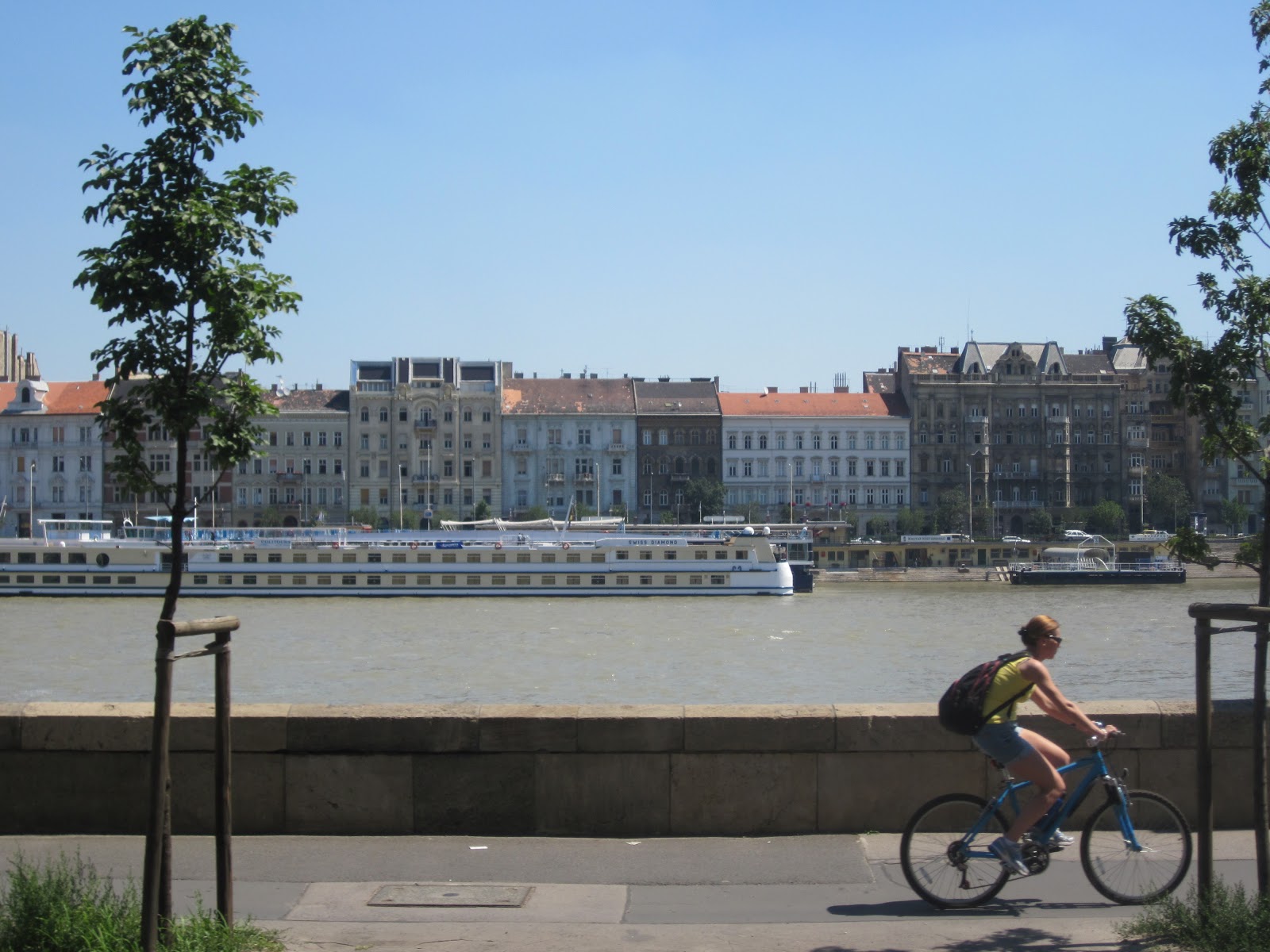
Looking at the many cruise boats on Pest (pronounced Pesht)

Why is Hungary called HUNgary?

As we know the Huns were mongols, an oriental race who attacked the Roman Empire. Under Attila they were pretty successful until 451 A.D. at the the Battle of Chalons sur Marne where they were defeated by General Aetius with his Roman troops and Visigoth warriors led by Theodoric. Repelled from Gaul (France under the Romans) they retreated to Rome & sacked it. The Huns could not resist a hefty “payoff” from the Romans if they would just leave. Then Attila died leaving his Mongol hordes disunited, quarreling, & weakened. Nevertheless, they continued their retreat to a vast plain to the northeast, a Roman province called Pannonia. The people there were Slavic and Celtic tribes, & Romans colonists.  By the time the battle-fatigued Huns arrived, the local population didn’t fight them, they merely assimilated them. Ever after the plain was called HUNgary. Physically, modern Hungarians do not exhibit much trace of their mongol heritage….except maybe high cheekbones & an admirable pugnacity.


One of the several bridges across the Danube linking Buda to Pest 

Arpad, St Stephen, St. Imre, & Mattias the Crow

Aside from the Huns becoming a part of the national DNA & the name, the real history of Hungary begins in with the Magyar Invasions & Arpad I who became king in 972. Lore has it that these fearless invaders came like a swarm of locusts from the east, undersized horsemen on miniature horses. Arpad I took control of Hungary and his lineage became the dynasty which ruled Hungary for roughly 6 centuries. Arpad’s son Stephen became the first Roman Catholic convert & the patron saint of Hungary. Stephen’s son, Imre, martyred at a very young age, was also sainted. Since then Hungary has always been Roman Catholic. The many kings that came from Arpad’s line spread their power & influence in neighboring countries & became the ruling aristocracy. Hungary reached its apex under Mattias Corvinus (the Crow) in the late 15th century, who is credited for being the first head of state to introduce the Italian Renaissance in his country.

The Turkish Takeover

The glory days ended soon afterward. I often wonder if life was just so peaceful that no one had the slightest idea of what would come next: The Turks. They came, they conquered, and remained for 150 years! After the heights, suddenly the nadir, a kind of Dark Ages for Hungary and surrounding countries, seemingly erased from European pre-eminence. But then, slowly the Austrian Hapsburgs began conquering these forlorn lands & chasing out the Turks. Hungary was unified with Austria...but the king was always a Hapsburg, always crowned in Bratislava, now capital of Slovakia. This rankled the pugnacious Hungarians because they never liked being bossed around. 

The Comeback

Hungarians kept right on rebelling until 1867 when the Hapburgs decided to do something different. They found that they could not reasonably oversee the newly acquired countries, Slovakia, Transylvania (Romania), Serbia, Croatia,  parts of Poland & Ukraine. So, they neutralized the troublesome Hungarians by making them the CEOs of the eastern part of their Holy Roman Empire. The Hapsburgs understood that under the Magyar kings the Hungarians had ably administered these countries--actually, preventing civil unrest between factions-- and that Hungarian aristocracy was already strategically placed in the large cities of each of these countries. Even through the Turkish occupation the stubborn Hungarians had endured. 


House of Parliament 
Lookin’ Good

The result of the alliance with Austria, known more familiarly as the Austro-Hungarian Empire, which lasted until WWI, brought great prosperity to Hungary, best seen in Budapest, that great capital on either side of the Danube. Buda is the old medieval city on a high hill; Pest, the young city on the opposing plain where there is no mistaking the Hapsburg architecture on massive, ornate public buildings and churches.  In recent years, almost all national treasures have been restored to their full glory. They gleam with fresh color and gilding.

Of WWI and WWII and the grim period of Soviet occupation I will say nothing, since places we visited do not have much to do with these events. However, recently the European Union has garnered the Nobel Peace Prize which has raised eyebrows and even protests. J.J. & I are of the opinion that for once the recipient was well chosen. Because the EU has placed conditions on membership there have been significant noticeable upgrades in Central & Eastern European countries. Here are a few observations made by a couple of mundane tourists between 2004 and 2012.
  1. Rule of Law - There is peace in the street and corruption has been curbed. This takes the simplest form comfort & relaxation in public places, or buying or paying for tickets and other services. If a regular citizen or tourist is law-abiding the state won’t arrest you on a whim.
  2. Transparency - The taxpaying citizens knows how tax money is used, in contrast to non-transparency when no one knows how the government operates or uses public funds.
  3. Modernization and repair of infrastructure - New highways have been built; streets have been widened and repaired. New codes of health are in place: streets & establishments are clean & free of trash; no smoking in public places; and clean, modern toilets everywhere. 
  4. All public buildings have been cleaned, refurbished, and modernized. Most are opened to the public or, for a fee can be visited.
  5. Touristic infrastructure - much improved with better trains, planes, city transit. Hotel accommodations & tourist information are abundant and fairly priced.
Very Hapsburg -- now peaceful and touristic


This is not an exhaustive list, but it will serve as launch for my next post in which I will discuss some of these things more indetail...with a few stories, of course.